
Letter from A Higher Elevation
Can Ancient Truths Help us Navigate "Fire-Horse" 2026?

Yes, I feel pretty calm.
I just came back from five days at a Buddhist retreat center. I was on a retreat that, profoundly enough, extended from the time of the dying of the old year, into the birth of the new.
The gathering was held in a pristine mountain valley. From the instant I had been dropped off, in sweeping depths of pure white snow, at my spartan dormitory, the air had felt electric.
I had breathed a deep sigh of relief as I entered the building, had pulled off my industrial-strength rubber snow boots, had aligned them with all the other boots in the stone-paved hallway, had made myself a cup of herbal tea from a simple stand, and had found my way to my room.
My room was monastic, but comfortable: a bed. One light overhead. A desk lamp. A simple wooden desk.
White linens, crackling with cleanliness. A blue printed mat on the floor, instead of a rug. A window that faced a sheer majestic wall of snowy mountainside. A framed photograph of an Indian rope-seller, wearing a blue turban, and peering curiously at the camera.
Down the hall was a women’s bathroom, with a separate area with showers for women. Men had their own accommodations. The large classroom, a lounge area, a shrine with a peaceful seated Buddha, were all on the level above where we slept.

There was, in short, everything one could need.
In the paradox that is our culture’s excess of selection and glut of abundance, the simplicity of it all filled me with joy.
When I stepped outside the dormitory, the sense of an energetic ‘vortex’ was intense. I wondered at how elevated the feeling was, like the echo of an echo left behind after the ringing of a silver tuning fork.
One of the event’s speakers would later explain that the bowl-like depression in the mountains in which we found ourselves, had been formed millennia ago by the strike of a meteorite. The meteorite was still underfoot, sunk half a mile deep beneath us living humans. Thus, the iron pyrite and other ores that had shattered into the depths of earth from that ancient catastrophe, had re-tuned the energetic field. The sense of our being within a vortex was enhanced by the fact that roads came into the valley and led in a circle to exit the same way, but no roads cut right through the valley.
All of it felt like a mad upwelling of life force.
The retreat center was made up of modest, elegantly structured, mostly-unpainted wooden buildings, showcasing some decoration from traditional Tibetan architecture. Massive evergreens stood solemnly in white fields between the buildings, their outstretched boughs laden with snow.
Across the valley ran a little icy stream; it descended from some unseen mountain elevation, frolicked over stones and between snowy banks, and plunged itself into the river perpendicular to it, at the base of the massive mountainside.

The brook was spanned here and there by simple wooden footbridges, with the clean, slightly arched railing-tops that you see in old Chinese landscape paintings. I saw this little nameless brook in daylight, morning and afternoon, and again in moonlight; I saw it under gusts of snow, and in the deep still darkness. With each encounter, I felt its livingness, even its personality and sentience, more obviously. With each encounter, the brook seemed to me more like an actual vein of the earth flowing into an actual artery. Was the animistic world after all correct in seeing life forces — even devas, or sprites or fairies — in every hill, every planet, every tree, every stream?
Simple steps — wooden edges filled in with unmortared gravel — had been carved up the hillside that led to the central dining and administration building. There were no railings, and no concrete risers, to these steps, which filled with snow; so ascending to, and descending from, meals, at least for me in my mildly crippled state, seemed almost metaphysically dangerous and difficult.
In the main building, plastered in a pleasing burnt-orange stucco, was the kind of welcome you imagine you receive in Heaven. Quiet, pleasant young men, volunteers and staffers, brought in logs at intervals, and kept a fire perpetually roaring in a big open stone fireplace. The fireplace, set deep in a thick wall, was almost five feet high, unlike smaller Western fireplaces; and so the heat that reflected out into the room was prodigious; a living heat.
At tables, retreatants gathered: I was among men and women from all over America. Most of them were middle aged or older. A few younger people had joined the event. When one spoke to many of the retreatants at any length, one learned that many, understandably enough, were here following a major life change — a retirement, or having been let go from corporate life; or having faced an illness or a bereavement or a divorce; or else, some people were at that beautiful place just to have a pause in the stress of modern life.
I felt so happy seated among the people from all walks of life who were in one place to learn some stillness and some wisdom. Being among humans who were together and off their phones, made me deliriously happy. The energy of humans joined in kindly conversation, sitting without technology mediating our contact, at wooden tables, eating lovingly-cooked vegetarian dishes — tempeh with a butter, wine and caper sauce, for instance, which I’d have assumed would be disgusting, but which was delicious; seasoned roast vegetables; brilliant orange butternut soup; poached pears scattered with walnuts — felt as if we were resting in a warm pool of benign, nurturing energy; a gentle merging — not an obliteration — of the energies of our individual selves. As my senses became more attuned to the world of energies as the days passed, I could feel the energy of someone in the room taking out his or her phone, as if it was a shard of lonely, damaging broken glass, within an otherwise mellow, comforting field with otherwise, no sharp edges.
I was not completely new to Buddhist cosmology or meditation practice. I had gone to a four-day silent retreat in Western Massachusetts, with my then-fiancee, when I was about 30, and the experience, brief as it was, had completely changed my life. I had learned at that time about the “Noble Eightfold Path,” and about “Right Speech”.
The Noble Eightfold Path was the former prince-turned enlightened being, Gautama Buddha’s, guide to the ending of suffering and the achieving of enlightenment. It is a set of goals that rests on three groupings: Wisdom, Ethical Conduct and Mental Discipline:
“Wisdom
1. Right View
Right view includes a correct understanding of the Four Noble Truths, the law of karma (the principle that our actions have consequences), and the impermanence and interconnectedness of all phenomena. It involves recognizing the nature of suffering, its causes, and the path to its cessation.
2. Right Resolve
Right resolve means cultivating wholesome and ethical intentions. This includes our intentions to renounce harmful actions, to develop goodwill and compassion toward all beings, and to cultivate non-attachment or non-harming.
3. Right Speech
False speech, divisive speech, harsh speech, and idle chatter are all considered unskillful and harmful and should be avoided. Instead, we should use our words to promote truth, harmony, and understanding.
Ethical Conduct
4. Right Action
Skillful action emphasizes ethical conduct and the importance of leading a life that is aligned with moral principles. This means refraining from harmful actions, including killing, stealing, sexual misconduct, and so on.
5. Right Livelihood
To engage in right livelihood means choosing work that is in harmony with the principles of ethical conduct and does not harm others. For example, this would include avoiding professions that involve harming sentient beings or engaging in dishonesty.
6. Right Effort
Right effort means making a persistent and diligent effort to cultivate wholesome qualities and eliminate unwholesome ones, abandon negative mental states, and nurture positive ones.
Mental Discipline
7. Right Mindfulness
Right mindfulness is the practice of being fully aware and present in the moment: observing our body, feelings, mind, and mental phenomena with clear and non-judgmental awareness.
8. Right Concentration
Right concentration is the development of a one-pointed, focused mind. This is achieved through meditation practices that allow the mind to become absorbed in a single object of concentration, leading to states of mental tranquility and insight.”
As a young journalist at that time, who had just suddenly, and disorientingly, become famous around the world after the publication of my first and second books, The Beauty Myth and Promiscuities, I was overwhelmed with the temptation that the world was presenting to me, of engaging for the rest of my life in unethical speech. I had recently been attacked by the public intellectual Camille Paglia, author of the bestseller Sexual Personae: Art and Decadence from Nefertiti to Emily Dickinson. Paglia’s attacks had seemed to me to come out of the blue, and they were blistering. She had called me, as I recall, “Little Miss Pravda”, among other insults. She also called me “the Dan Quayle of feminism — a pretty airhead who has gotten any profile whatsoever because of her hair.”
I did not at that time process the fact that Paglia had been mentored and taught by the professor who had aggressed against me sexually at Yale, just a few years previously, Prof Harold Bloom; his sponsorship of her work could indeed explain this otherwise shocking and random caricature.
When I finally named him publicly, in 2004, Paglia was sent to attack my account of this event as “indecent”; his had been an indecent offense indeed, but the indecency was not mine.
That year she would claim that “Naomi Wolf, for her entire life, has been batting her eyes and bobbing her boobs and made a profession out of courting male sexual attention and flirting and offering her sexual allure.”
Later I would understand why Paglia had been deputized to seek to take me out reputationally before, and again just when, I named a powerful man as having committed a crime.
But as I sat in the cool, ascetic meditation hall in Massachusetts in about 1992, I did not know why Paglia kept coming at me, with her teeth bared. I was tired of fighting. I had started to counter-attack — having called her in return, I regret to say, “the nipple-pierced person’s Phyllis Schlafly” — and I was now horrified to think that I was facing a lifetime of such pitched battles.
It was in this state that I went to sit in silence in the Western Massachusetts woods.
Would I spend the rest of my life burning up any talent I had with words, in trafficking in snarkiness and gossip, which were the coins of the realm at that time in mainstream journalism? Or would I try to do good, as the “dharma teachers” to whom I listened then explained “right speech”, with my facility with the written word and with language? I think that that retreat, and those few “dharma talks” — especially the one, as I will never forget, taught by the distinguished teacher of Buddhist ethics and meditation, Sharon Salzberg — set me on one road of the two that had diverged, as Robert Frost wrote once, in his poem “The Path Not Taken”, “in a yellow wood.”
“I shall be telling this with a sigh
Somewhere ages and ages hence:
Two roads diverged in a wood, and I—
I took the one less traveled by,
And that has made all the difference.”
That long-ago retreat pulled me back from the edge of a moral abyss.
I did not spend the next decade or two cat-fighting publicly with Camille Paglia. Mostly, I ignored her.
I wrote other books, and raised my children, and loved people, and tried to learn things, and engaged in activism.
When I ran into Paglia one day at a conference, I approached her and said something like, “We really should make peace.” Paglia averted her eyes from me, did not reply, and scuttled away.
In 2023, nonfiction writer Naomi Klein, with her would-be savage book Doppelgänger: A Trip Into the Mirror World, was similarly deputized to take me out reputationally when I sought to name an entire industry, the pharmaceutical industry (in which her husband and father-in-law are so deeply embroiled) as having committed the most massive of crimes: an assault on the future of humanity itself.
Because of Sharon Salzberg, really, and her patient explanation in the 1990s of what the Buddha was trying to communicate, and that long-ago four-day retreat, I did not spend 2023 to the present, attacking Naomi Klein back, or responding to her claims, or even ruminating about her attacks on me, though I was often invited to do so, publicly.
I never even read her book.
Life is far too short, and there is too much poison in this world as it is.
I spent 2023 to the present trying to save lives, by keeping focused on the prize of bringing the truth about the mRNA injections to the world; and I acknowledge that I, with help, saved many lives by doing so.
If I had not heard the ethics of using language spelled out so clearly 30 years ago, I might be looking back on a lifetime of regret and bitterness.
I might have had worldly success enough, but be looking back at a horrible life, of having chosen day after day to use language as a cudgel, destructively, leaving wreckage and pain behind me; rather than having chosen, at least in my intentions, to use language as a scalpel to isolate disease, or as an embroidery needle to make something more beautiful; or as a trowel for, as I hope, embedding and protecting and securing for the uses of the future, precious seeds.
The Buddha said, as Ms Salzberg explained, in her many books and talks, including her wonderful book Lovingkindness: The Revolutionary Art of Happiness, that we should be grateful to our “adversaries” for their being among the greatest of our teachers.
In Luke 6, 27-31, King James Version, Yeshua says something similar, to a crowd:
“27 But I say unto you which hear, Love your enemies, do good to them which hate you,
28 Bless them that curse you, and pray for them which despitefully use you.
29 And unto him that smiteth thee on the one cheek offer also the other; and him that taketh away thy cloak forbid not to take thy coat also.
30 Give to every man that asketh of thee; and of him that taketh away thy goods ask them not again.
31 And as ye would that men should do to you, do ye also to them likewise.”

Camille Paglia is now 78. May she find peace and grace in her lifetime.
Naomi Klein, God bless her, is only 55. She has plenty of time to take a better path — the best path. May she do so.
Prof Bloom is no longer on this planet, and whatever he faces is not my business, nor is it in my hands.
The point is, the passage of time and, I think, the justice of the universe, sort out our battles for us.
My job was to tell the truth. I did so.
My job with the critics, is to push back to correct the record until it is right. But it is not my job to get down into the muck with others who seek to pull me down into it. It is my job to stay true to my own path, my “dharma”, and turn neither to the left nor to the right as I pursue it.
So thank you, Sharon Salzberg, and Gautama Buddha, and Jesus, for saving me three decades of wasted energy and effort.
Thank you Camille Paglia. Thank you Naomi Klein.
(I cannot thank the memory of Professor Bloom yet for the pain he caused the traumatized 19-year-old me, twelve years after I had been raped as a child so violently that the damage led my very bones and tendons to develop awry. But someday — I may evolve to be able to do so.)
The retreat this past week refreshed my understanding of Buddhism 101. (And by the way, for my faithful Christian and Jewish readers, please do not fret; Buddhism is a philosophy rather than a religion, and one can use its wisdom while still being fully Jewish or Christian, Hindu or Shinto, or so on. )
I also learned more, at this event, that was useful to me.
I learned from an astrologer at the gathering, who “read the chart” of the United States of America for 2026, that the year was going to be “like a horse on fire.” He explained that the planets of our nation are in the exact same alignment that they were in 1776, when the Declaration of Independence was signed; and the same alignment as in 1861, when the Civil War broke out.
He said that we were facing, as a nation, either a breakdown or a rebuilding and restructuring.
He used what is called “the Sibley Chart”:
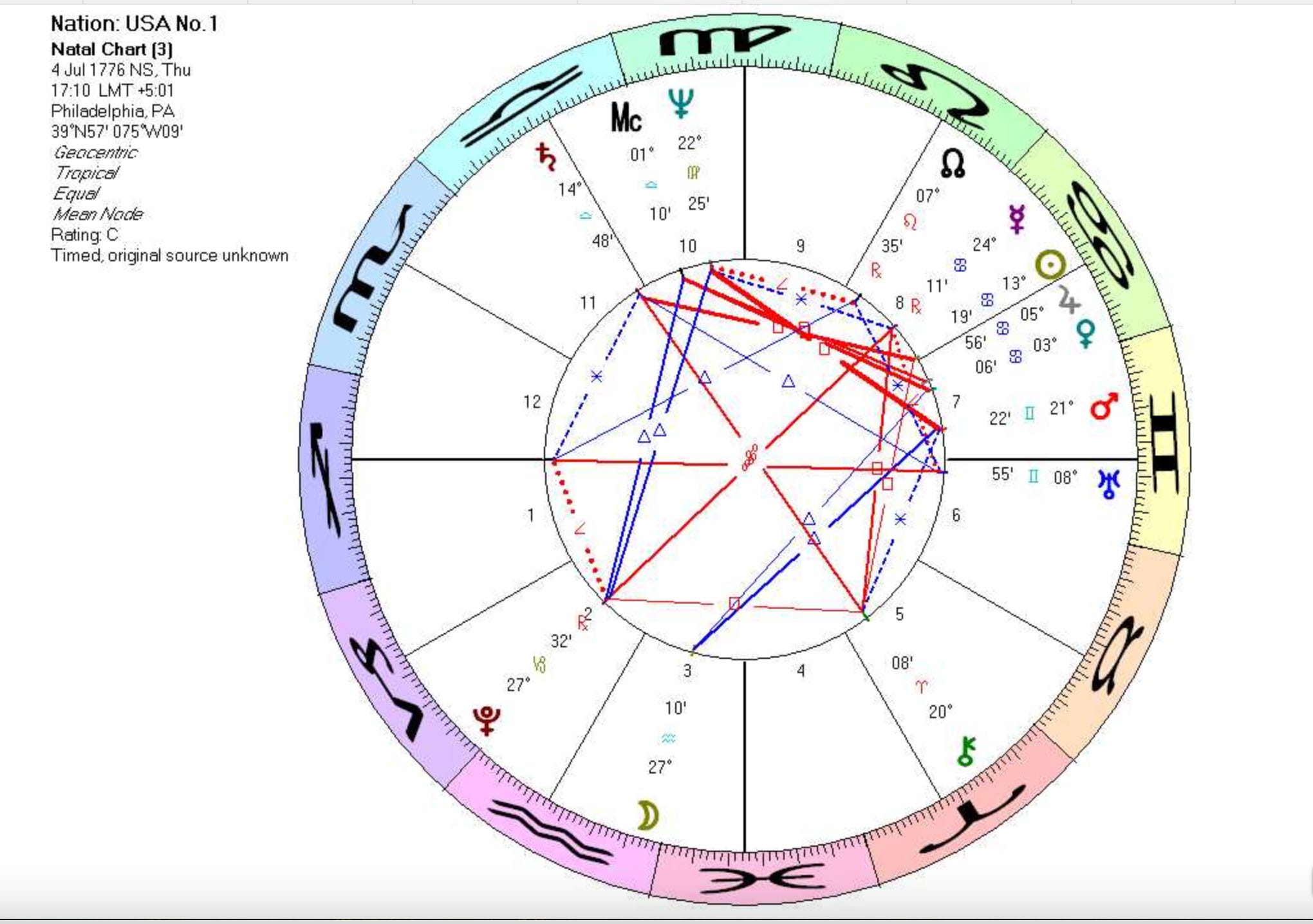
I learned that as fast as events seemed to unfold in 2025, they would unfold with even greater velocity in 2026; and there is to be no stopping this momentum.
We have entered the Age of Aquarius, many astrologers agree, and old structures that no longer serve us are exposed, and have collapsed or are collapsing.
You can be skeptical of astrology, but look back at 2025: that actually happened - the collapse and invalidation of institutions, beliefs, personalities, structures, even taboos protecting the secrets of the powerful; and it all happened in a way that was more forceful and obvious and unstoppable than has been the unfolding of history in any other, more ‘normal’ year in my memory.
I learned from another teacher at the event, of the power of setting intentions. She advised us to write down our intentions for 2026, as a “love letter to the year”, and then place the list in a box; and then, we should take this list out at the end of 2026. We will be amazed, she said, at how many of our intentions manifest.
I was skeptical — this, I scoffed to myself, is the kind of thing upon which Lifetime movies are based — but then I made my list, and the most important one that I named, manifested by noon on the following day.
I heard a great musician and his band — including in it a cellist, a traditional flautist and an organist — share “kirtan”, or Hindu sacred chants, for three nights running. My body literally hummed.
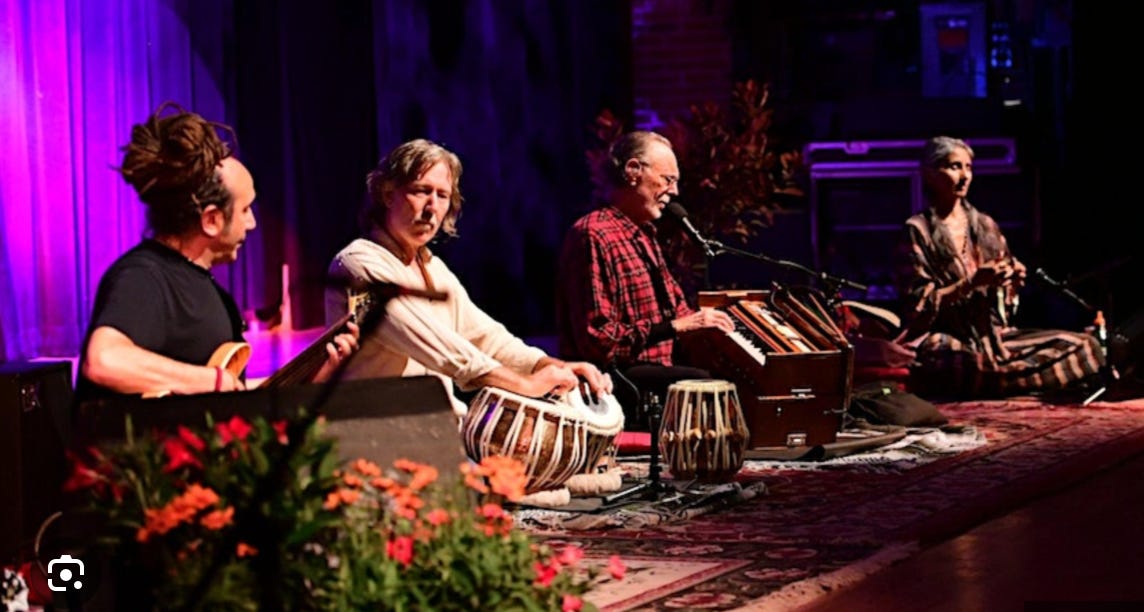
Later, I lay on a futon in a large, darkened room, with a hundred other people also lying on futons, all of us with our eyes closed; as another set of musicians treated us to a “sound bath”, using brass bowls, tympanums, birdsong, water-song, and the resonance of gongs.
After the third day of such practices, I felt so good that I was sure something real had taken place. Vibration, along with light, our teachers reminded us, have been used for centuries in the arts of healing. Our teachers pointed out that the use of light and sound in healing is a return to tried-and-true methods — not an innovation.
I made my way home to my room each night under icy stars. The paths were treacherous some nights, or deep in snow; and at times, as you know, I have trouble walking.
The astrologer and his wife, with whom I made friends as the week unfolded, both one night kindly walked me home. They wanted to make sure that I would not slip on the unstable terrain.
At the bottom of the hill that led to my monastic room, we paused and looked skyward. Darkness enfolded us like a transparent cloak.
The astrologer pointed out Orion. There was Jupiter, he showed me. Jupiter’s rings were shifting, seen from Earth’s point of view, he had explained, a fact that amazed me. There was the Big Dipper.

I had never really known what I was looking at, when I looked at an astrological chart, or, for that matter, at the pattern of the night sky’s stars.
But now I understood — a bit — what I witnessed. I was looking at light from thousands, millions, or even billions of years in the past. The stars were looking at us, perhaps — at us, thousands or millions or billions of years in the future.
I was looking at patterns that men and women had sought out for guidance for millennia — since before the marking of time, or the use of language as we know it, or the tracking of history.
I had asked the astrologer, after his earlier presentation, “If all this is foreordained, what is the point of activism?”
He had explained that nothing is foreordained; but rather, that these patterns in the movements of the planets are what he called “signposts.”
The stars bathed me with their visible presence, sent from an entirely different dimension of time.
There are many timelines on this planet.
All of the major astrologers are predicting that 2026 will reveal a further “splitting of the timeline.”
Some people will be with us, they explain; and others will be — not ‘left behind’, exactly, but rather, that these people, these souls, will remain connected to another reality that will seem increasingly to us to be unreasonable, dead, or part of the past.
I felt — paradoxically — an ease that I have not felt since I was an adolescent.
Yes, I have had my role to play. I have stepped into a battle or two, or several, in the history of my lifetime, when it was my dharma — my duty — to do so.
I have recognized, in short, the battles that had my name on them.
But now, maybe, I saw — I saw again, as I last had done as a teenager, before I abandoned poetry for good, after the assault at Yale — that there was a music to the whole damn universe; and I saw that this music was as important for me to understand, as was my engaging simply in more combat.
Maybe understanding, and declaring, that music, was even more important than combat.
Maybe the battles of 2026 will unfold as signposted — without me and my ultimately small efforts; or at least, maybe these battles will unfold as necessary, without me being so exhaustingly in the trenches.
Maybe I do more good — now, 2026 — by re-entering the universal poem — the poem, that is, that is the universe.
Maybe I do more good by holding the biggest possible picture — the stars and the river, my loves and my “enemies”, the past and the future, the stones in the brook and the humming of the buried meteorite; by my holding history and eternity, my deaths and all of my lives —
Steadily
Within my heart.
Happy New Year
Small everyday acts can sometimes turn into big changes. It’s in the ordinary obedience, when you’re serving, giving, loving, that you’re creating legacy. You don’t need to be in the spotlight, or have a large platform, if you do that’s great, but your impact is just as real and just as powerful. It’s not always the big moments that build legacy it’s the small steps of daily faithfulness. The things you do quietly when no one applauds. Those actions that seem small, God keeps the records of. What you do in secret, what nobody gives you credit for, God said he’ll reward you openly.
A mathematician and weather expert named Edward Lorenz came up with a theory that a butterfly fluttering its wings could set off a chain reaction that could create a hurricane in Texas. That small insignificant motion had the power to set off a major shift. Of coarse people discounted it but he was able to prove scientifically how that slight change in the atmosphere created by a simple flutter of a butterflies wings could lead to this incredible weather pattern. Sometimes small ordinary actions can create a ripple effect that will cause much larger events to occur. This is the connection, when you go about your routine each day, it can seem ordinary like not much is happening, but your obedience is setting in motion things you can’t see. There’s a ripple effect taking place. God is orchestrating things that will have a greater impact, more significant than you could ever imagine. This is why the enemy tries to take away ordinary America. They try to make what we do seem insignificant. Don’t believe this, your life makes a difference, people are watching you, your family, your friends co-workers, your actions create influence.
Sometimes God hands you a gift. This past spring I was driving into Home Depot to get materials for my days work. I didn’t get far into the parking lot and I saw a wallet sitting on the asphalt, I stopped and picked it up. I took a look and there was a folded bunch of 20 dollar bills, some foreign currency, a family picture and of coarse a man’s drivers license. It appeared the man was originally from India and a picture showed his wife and two children. I googled his name but couldn’t find a phone number. He lived 2 towns away, so I decided I’d go in to get my materials and then drive to his house and drop the wallet off. It was a bit of a drive, when I got there I knocked on the door. An Indian woman hesitantly opened the door and in brocken English said can I help you. I told her I found her husbands wallet at Home Depot, knew he must have been worried, and wanted to get it back to him. She said he had called her and was a nervous wreck. She thanked me and I left. She didn’t take my number or my name but I’m sure the hour I took out of my day made a positive impact in those peoples lives. The good feeling I got was all the reward I needed.
So many times it’s our ordinary routine actions that can make the biggest difference. In John 6 there was a woman that had no idea how much she mattered, and how God was going to use something routine in her life to have such a tremendous impact on others. Her list of things to do was as long as usual but first she had to pack a lunch for her son. She only had two small fish left over from dinner and 5 small loaves of bread. As she began packing his lunch, she never would believe what would happen later that day. There was a huge crowd of people listening to Jesus teach. It was late in the day and they asked Jesus if they should dismiss the people so they can go find food. Jesus said you feed them. They were puzzled and said we don’t have that kind of food to feed all these people. Jesus asked well what do you have. So they searched the whole crowd and all they came up with was the little boys lunch with the two fish and the five loaves of bread. They gave it to Jesus, he blessed the food and it multiplied and ended up feeding over 5000 people, with twelve baskets of food left over. We hear a lot about the miracles of multiplying the food and I’m sure you have heard that story but it all started with a mother being faithful. She thought it was just a routine day checking off her to do list but it was part of a much bigger plan, something she couldn’t see right then. A divinely orchestrated moment that years later would still be inspiring us. That’s the butterfly effect. The relationship between small movements and big events. How could something as routine as taking care of your family have that kind of effect. Going to work being your best and doing it all over again. It feels so normal. You’ll never know the impact of your faithfulness. Keep honoring God, being good to people, going the extra mile you’re making a difference.
The scripture says don’t despise the day of small beginnings. God loves to take our small and do big things. He’ll use what we consider insignificant or ordinary to have a tremendous impact. Your steps are being ordered by the Lord. God has these destiny moments. It can seem ordinary but you don’t know what God is up to. As you keep being faithful in your everyday life you will be openly rewarded by God. J.Goodrich
What is so achingly profound about this letter is your total honesty and openness. I felt like I was there with you in the woods with the snow and the brook and the pines and the DEEPNESS. I’ve been dealing with some “attacks” recently and you’ve reminded me how they should be approached, or not! Why wrestle with the Devil? :-) Thank you, dear Naomi.